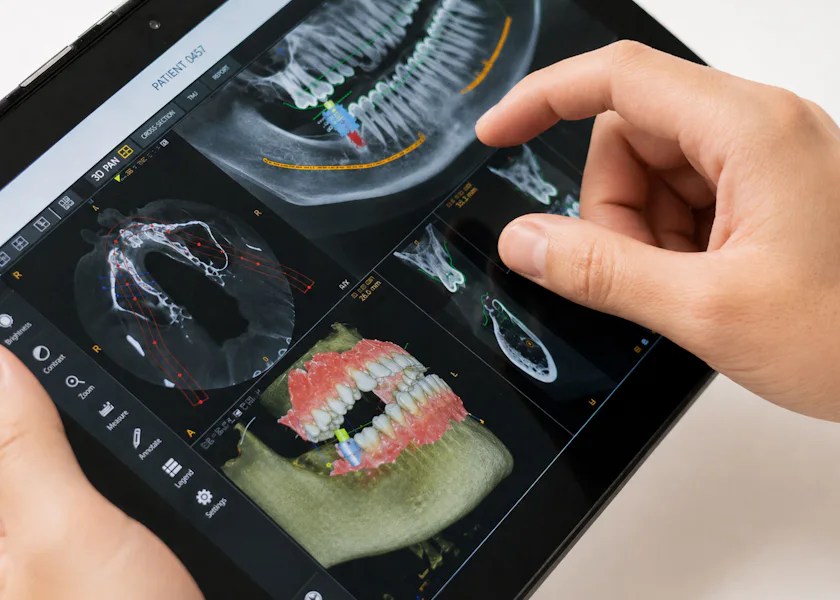
Replacing missing teeth can involve a series of decisions, not a single purchase. Our dental assistance homepage explains public and charitable care, while our dental grant application comparison distinguishes volunteered treatment from private discounts. This guide focuses on the amount you actually owe and the risks of paying for surgery with borrowed money.
People looking for low cost dental implants often see an attractive opening price for a metal post. The complete restoration may also require a consultation, imaging, extractions, treatment of gum disease, bone grafting, the implant abutment, a crown or overdenture and follow-up care. A fee for one part is not the same as the total cost of the final tooth.
There is no single national government grant that pays for any implant chosen by any adult. Some medically necessary dental services may be available through Medicaid, VA care, private plan benefits or a volunteer charity, subject to eligibility. A supervised university clinic may charge less than a private practice without providing treatment entirely free. Commercial cosmetic “grants” can operate as reductions in participating dentists' fees rather than cash awarded to patients.
The safest order of decisions is to obtain a clinical evaluation, ask for viable alternatives, compare complete written estimates, confirm all insurance benefits and donated treatment opportunities, then decide whether borrowing is worthwhile. It can be reasonable to delay elective surgery while stabilizing oral health and seeking lower-cost care if a dentist agrees that delay is safe. Urgent infection or medical complications should not wait for a financing offer.
Before signing any loan or medical credit agreement, ask for an itemized estimate including the final restoration, any grafting, imaging, extractions, maintenance, financing charges and what happens if the planned treatment changes.
Single tooth implant vs. snap-in overdenture vs. full-arch All-on-4
A single-tooth implant generally involves one fixture in the jaw, an abutment and a crown. The implant replaces a tooth root rather than an entire row of teeth. If a neighboring tooth is healthy, a dentist may compare an implant-supported crown with a conventional bridge or removable partial denture. The clinical condition, bone support, infection risk and ability to keep the area clean affect which option is appropriate.
An implant-retained overdenture uses a removable denture that attaches to strategically placed implants, sometimes two in the lower jaw. It is not the same product as a fixed full-arch bridge. A person who already has a suitable removable denture may still need new attachments or a different denture design; ask the dentist what components must be fabricated and whether the existing appliance is compatible.
All-on-4 is a branded technique that uses a small number of implants to support a full-arch fixed prosthesis in suitable cases. The term is often used broadly in advertising, but different implant systems, surgical methods and restorative materials affect price and longevity. A full-arch case may require extractions, temporary prosthetics, bone-related preparation and a later permanent restoration. Not every patient is a candidate.
Ask for two or more clinically reasonable treatment plans that address the same problem. For a person missing several teeth, an ordinary denture might restore acceptable chewing function at much lower surgical risk and expense than a fixed implant arch. Another patient may benefit from implants after a thorough assessment. Neither should decide based only on a promotional illustration.
Clinical market benchmarks show private implant care often runs several thousand dollars, while academic prosthetic services can cost significantly less. Rates vary by treatment and provider, and are not nationally guaranteed prices. See the University of Illinois Chicago dental school's cost guidance. Individual quotes differ by geography, materials, provider training, insurance and the precise treatment. Avoid treating an advertised $900 overdenture as a national school guarantee or assuming a full arch costs exactly $24,000.
| Single titanium implant with crown | Implant post, abutment and final crown; grafting/imaging may be separate | Clinical candidacy, available dental coverage and provider assessment | Full written surgical and restorative quote required | Multiple stages and healing · School programs |
| Two-implant snap-in overdenture | Removable denture retained by implants, attachments and maintenance | Adequate bone, prosthodontic plan, clinic intake | Costs vary; a $900 total is NOT a guaranteed national school price | Staged visits · CODA |
| Full-arch fixed restoration / All-on-4 | Full-arch prosthesis retained by multiple implants | Individual surgical and prosthetic assessment | Private comprehensive quote; no general free arch grant | Surgery, healing, final prosthesis · Research schools |
| Dental Lifeline Network DDS (EIN 84-6129064) | Volunteer-selected dental care; implants not guaranteed | 65+, permanent disability or medically necessary care plus financial hardship | Potential $0 if accepted, treatment chosen by volunteers | State waitlists · DDS |
| HRSA health center sliding fee | Local services in clinic's approved dental scope; implants not assumed | Income at or below 200% FPG for schedule discounts | Nominal or partial clinic fee, services and policy dependent | Local enrollment · HRSA |
| Private medical finance or bank/credit union | Loan or medical card to pay a dentist; not a treatment subsidy | Lender underwriting, contract, credit and ability to repay | Principal + APR, fees, possible deferred interest | Approval varies · CFPB |
The table compares service scope and financial considerations, not fixed national fees. Request written estimates for the total completed restoration, not just the implant post.
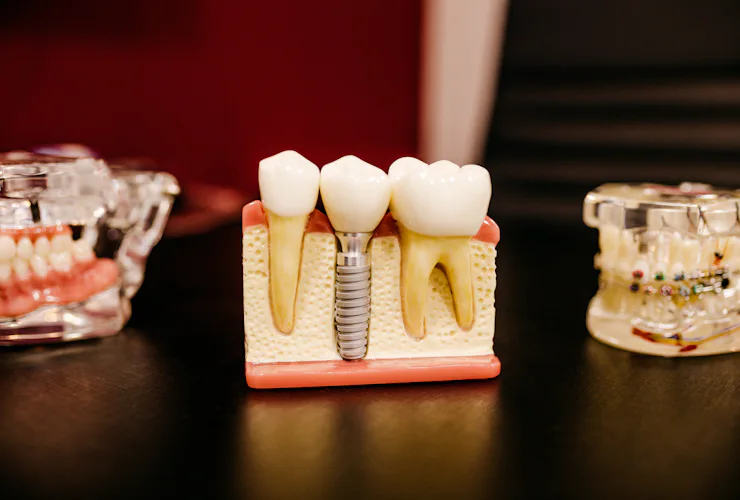
What an honest implant quote should include
First ask whether the consultation and diagnostic imaging will be billed separately. Cone-beam computed tomography can be useful for implant planning in some cases but is not necessarily included in a quoted surgery fee. An assessment of gum health and treatment of infection or decay may be needed before implants are considered.
Second, list every surgical and restorative stage: removal of an unsalvageable tooth, grafting if clinically necessary, implant fixture, abutment, temporary tooth, final crown or denture, anesthesia, laboratory work and follow-up. If you receive treatment at more than one office, ask each provider for a statement of its own charges and responsibility if a complication occurs.
Fourth, ask whether the plan uses a manufacturer-specific implant system and how future repairs will be handled. This is relevant if the original office closes or if you later move. Get copies of treatment records and device information through the provider's established process.
Finally, compare choices using the total cost and the proposed period of financing. Request an actual loan amortization schedule and ask which charges could be owed if care stops before the planned full restoration.
What cosmetic dental “grants” and partial fee reductions really mean
Some private networks use “dental grant” language for a percentage reduction at a participating cosmetic or implant practice. A patient's remaining balance may still be substantial, especially if preparatory extractions, gum treatment, sedation or grafts are excluded. Program eligibility may include a clinical examination and the requirement to complete basic treatment first.
Private Cosmetic Dentistry Grants and DentalGrants.org describe commercial or privately organized participation systems. They are not universal federal programs. If a marketer advertises a reduction of 25%–30%, ask for the written discount basis, the normal price before the discount, participating provider rules, treatment exclusions and any upfront payment requirements. Do not assume the percentage is a federal subsidy.
Applicants searching for All-on-4 dental implant grants sometimes receive invitations to finance an expensive treatment rather than an actual donation. A discounted $20,000 service can remain unaffordable, even if the sales page calls it an award. Compare the offer with a university clinic quote or a conventional removable solution evaluated by an independent dentist.
By contrast, Dental Lifeline Network's Donated Dental Services program relies on volunteer dentists and laboratories for selected qualifying patients, typically involving age, disability or medical-need criteria combined with financial hardship. It does not promise implants or a preferred commercial technique, and state waiting lists may be long. A low-cost school clinic is a third category: it may charge a reduced patient fee but is neither an insurance benefit nor automatically a charitable gift.
Read the official DDS program requirements and compare them with any private offer. Ask for paperwork identifying the actual organization and the treatment being funded before releasing money. A supposed agent who guarantees a federal implant grant in return for a processing fee should be treated with caution.
Dental implant financing for bad credit: compare APR, terms and deferred interest
Marketing for dental implant financing for bad credit can make approval sound simple, but the most important question is what the credit will actually cost. A credit score or approval decision does not tell you whether the proposed treatment is medically necessary, and a lender's willingness to lend is not proof that the payment fits your budget.
Personal installment loans from banks or credit unions, patient payment plans, medical financing companies and medical credit cards have different terms. Compare annual percentage rate (APR), financed principal, origination fees, monthly payment, late charges, prepayment rules, total repayment, any variable rates and credit-reporting consequences. Ask for a disclosure you can keep and review at home.
Medical credit cards may advertise “no interest if paid in full” during a promotion. The Consumer Financial Protection Bureau explains that these can be deferred-interest products: interest can accrue during the promotional period and be charged retroactively if the promotional balance is not fully paid by the deadline. This is different from a true zero-percent introductory APR that begins charging interest on the remaining balance only after the introductory period.
The CFPB has also warned about patients receiving confusing dental financing explanations at the point of care. A patient in a dental chair should not be pressured to complete a credit application before receiving a written treatment estimate. The dentist's clinical recommendation, the patient's agreement to treatment and the lender's credit contract should be separate decisions.
CareCredit, Sunbit and LendingClub: examples, not endorsements
Private firms such as CareCredit, Sunbit and LendingClub may offer dental financing at participating practices or through their own loan systems. Products, rates, merchant acceptance and disclosures can change. We do not rank them as universally cheaper and do not promise approval, low rates or an affiliation. A lender's name alone does not determine whether a deferred-interest offer, fixed-rate installment loan or other agreement is appropriate.
Before using any medical credit product, read CFPB's medical financing guide. If the promotional period is 12 months, calculate how much must be paid before its end, including any fees or payment timing restrictions. Consider whether a job interruption or unexpected medical bill would make the required payment unmanageable.
Some credit unions may offer personal loans with clearer installment schedules. Community Development Financial Institutions (CDFIs) serve certain communities, but CDFI certification does not guarantee a dental implant loan. Research any specific lender's eligible uses, underwriting, state availability and costs rather than assuming a nationwide federal medical microloan program exists.
IRS Publication 502, HSA and FSA: eligible dental expense basics
The Internal Revenue Service's Publication 502 explains how qualifying medical and dental expenses may be considered on a federal income tax return. It expressly includes eligible treatment to prevent or alleviate dental disease, including X-rays, fillings, extractions and dentures. Purely cosmetic procedures that do not meaningfully treat disease or injury may be excluded. Whether a particular implant procedure qualifies depends on its medical purpose and the taxpayer's circumstances.
A federal itemized medical expense deduction under Schedule A generally applies only to the part of unreimbursed qualified medical and dental expenses that exceeds 7.5% of adjusted gross income (AGI). The standard deduction versus itemizing also matters. If an individual has AGI of $50,000, the threshold is $3,750. Paying $5,000 in otherwise qualifying unreimbursed care would leave $1,250 above that threshold, not a $5,000 tax refund. This illustration does not determine a tax return's actual deduction.
An HSA can permit tax-free payments or reimbursements for qualified medical care when the account's rules are met. A health FSA can also reimburse qualifying expenses under its employer plan. You generally cannot both take an itemized deduction and receive a tax-free HSA/FSA reimbursement for the same cost. Documentation and timing rules matter.
If you are over 65, on Medicare or have a particular employer plan, ask your tax preparer and account administrator about HSA contribution rules and eligible distributions. Enrollment in Medicare generally affects eligibility to make new HSA contributions, but qualified HSA withdrawals can still be used as permitted. Do not assume that a card carrying the label “health” automatically approves a cosmetic procedure.
Consult IRS Publication 502 and IRS Publication 969 on tax-favored health plans. The currently posted publication may relate to a previous tax year; review the version applicable to the year when you file and ask a qualified tax professional about unusual circumstances.
Eligible tax treatment may reduce taxable income, not necessarily produce a dollar-for-dollar rebate. A tax return filed later cannot be relied upon as cash available for an immediate surgical bill.
Medicaid dental waivers: what adult benefits actually cover
Under 42 CFR § 440.100, Medicaid defines certain dental services that may be covered within a state program. The regulation does not require every state to provide every dental treatment to all adults. Medicaid.gov explains that states have broad flexibility to determine adult dental benefits and that there is no uniform nationwide adult dental minimum.
Some states cover routine dental care, fillings, tooth extractions or certain dentures, while others offer more limited benefits. Implant-supported restorations may be excluded, restricted to specific diagnoses or require prior authorization. A dental plan's approval of a removable denture does not automatically include titanium implant fixtures, grafts or an implant-supported fixed bridge.
The term “waiver” is sometimes used in advertising as if a person can request a general federal waiver to have elective implants paid for. Section 1115 Medicaid demonstrations and state plan amendments are public program mechanisms with defined populations and benefit designs; an individual generally cannot create a new covered implant benefit by submitting a generic online waiver request.
Call the state's Medicaid dental member-services line and ask whether your current plan covers the proposed procedure codes, whether a dentist must submit a prior authorization and which participating practices can provide the service. If coverage is denied, request the plan's written reason and the applicable appeal process. Accurate clinical documentation must come from the treating dentist, not from a template falsely certifying medical necessity.
Our dentures and Medicaid guide explains why a conventional prosthesis may be covered when an implant is not. Compare the full dental plan with a university clinic or charity option before deciding to finance surgery privately.
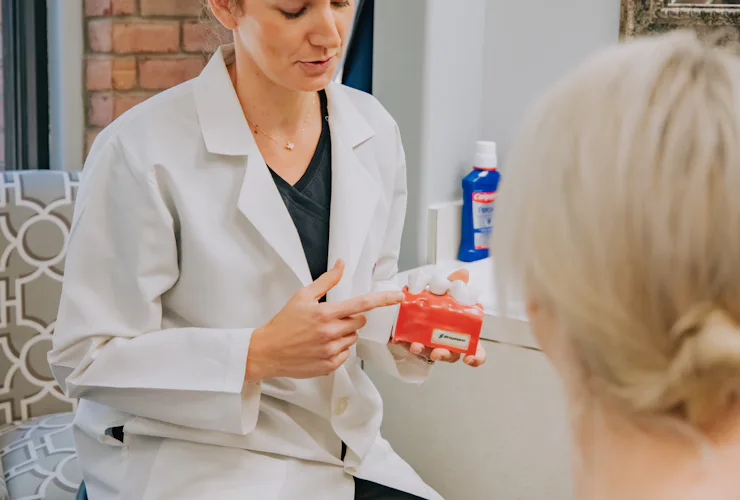
Compare HRSA sliding-fee eligibility and implant out-of-pocket scenarios
Health centers supported under 42 U.S.C. § 254b generally provide income-based discounts for covered services in their approved scope. Under HRSA's sliding-fee guidance, a patient with income at or below 100% of current federal poverty guidelines receives the prescribed full discount or a center-defined nominal charge. Patients above 100% and at or below 200% receive graduated partial discounts; those above 200% do not qualify under the required federal schedule.
For a single-person household in the contiguous states and DC, the 2026 HHS guideline is $15,960, so 200% equals $31,920. Alaska and Hawaii use separate figures. The estimator below calculates an approximate bracket and offers examples of treatment costs to discuss. A bracket does not mean a particular center performs implants or that the advertised price is available.
HRSA sliding-fee income & dental cost planning estimator
Compare your annual household income against 100% and 200% of the 2026 HHS poverty guideline. FQHC sliding-fee eligibility and prices depend on the actual health center and available services. Implant cost figures are planning scenarios, not quotes.
Sources: HHS poverty guidelines and HRSA sliding fee discount guidance. Actual costs depend on treatment and clinic policy.
Your income remains in your browser. No health center fee is promised. The clinic decides service availability, the allowed discount and any separate referral fees under its policies.
University clinics and prosthodontic residencies can offer useful comparisons
Dental schools accredited by the Commission on Dental Accreditation provide supervised care through student or resident clinics. Some offer implant evaluations, periodontal work, oral surgery or prosthodontics at fees lower than local private practices, but availability and prices differ. A school does not guarantee a $900 implant-retained overdenture or free surgery.
Ask for a treatment plan from a general clinic and, if appropriate, a specialist residency clinic. Request an itemized comparison covering the same teeth, the same type of prosthesis and all surgical and laboratory steps. A reduced student clinic fee might be offset by travel, multiple appointments and a longer treatment timeline, particularly if you must take unpaid time off work.
Use the official CODA-accredited program finder and contact the university's patient care office directly. For research trial opportunities, consult our dental schools and ClinicalTrials.gov guide. Trials have their own protocols and should not be confused with a general free-treatment program.
Six questions before signing an implant loan or discount agreement
- What is the total all-in treatment price?
Include examination, imaging, extractions, implants, prosthetic components, final restoration, appointments and repairs, not just the advertised surgical step.
- What would a simpler clinically suitable alternative cost?
Compare an ordinary denture, partial denture or bridge where the treating dentist says it is appropriate.
- Which coverage or assistance has been confirmed in writing?
Check state Medicaid, employer dental benefits, Medicare Advantage supplemental rules or an approved nonprofit case before agreeing to financing.
- How much will I repay, including every charge?
Look beyond the monthly amount to APR, fees, total interest, promotional expiry and the potential of retroactive deferred interest.
- Who handles maintenance and complications?
Confirm who will repair an implant-supported appliance, how emergency follow-up works and what future visits may cost.
- Do I have time to read the agreement?
Do not allow a one-day discount deadline to prevent you from requesting records or considering an independent second opinion when care is elective.
Someone who needs urgent care for infection or uncontrolled pain should seek timely medical or dental assessment before elective financing decisions. A financial offer does not substitute for treatment of an active oral health problem. Our emergency extraction and charity clinic resource explains the safe urgent-care pathways.
Historical Program Evolution: From 2018–2020 HRSA Oral Health Grants to 2026 Dental Assistance
University care, Medicaid adult dental programs and clinical charity networks have evolved over many years. Credit terms and private implant promotions also change, and a 2022 “grant” marketing offer should not be assumed currently available. Compare current provider estimates with current benefit disclosures rather than treating old advertisements as binding.
| Period | Program development | Current action |
|---|---|---|
| 2018–2019 baseline | HRSA, dental schools, charities and Medicaid adult benefits offered different access routes. | Check available coverage before applying for credit. |
| 2020–2022 care disruptions | Pandemic disruption affected dental school schedules and elective surgery, creating backlogs. | Do not extrapolate old quotes or appointments. |
| 2023–2025 finance and coverage changes | CFPB published medical credit warnings; state adult benefits and dental credit terms changed. | Read current loan agreement and state dental handbook. |
| 2026 research cycle | IRS medical-expense rules, HHS income tables and active clinic/charity listings were reviewed. | Use current tax-year guidance and independent estimates. |
Our clinical archive spans from April 2018 through our October 2026 review. Year-specific HHS poverty thresholds in the calculator remain labeled 2026 until updated from an official HHS publication, even when the article edition title rolls forward.
Dental implant costs, credit and Medicaid FAQs
Can I get dental implant financing for bad credit?
Some banks, credit unions and private medical finance companies consider applicants across credit profiles, but approval and APR vary. Compare total repayment, deferred-interest terms and alternatives before agreeing to a loan.
Where can I find low cost dental implants safely?
Ask an accredited dental school for a supervised evaluation and an itemized treatment estimate, and verify any dental insurance coverage. A school may charge lower fees but cannot guarantee a fixed national implant price.
Are All-on-4 dental implant grants paid by the federal government?
There is no universal federal cash grant covering full-arch elective implant surgery. Many private grants are partial discounts at participating offices, so the patient may still owe a substantial treatment balance.
Does Medicaid cover titanium implants with a waiver?
State adult Medicaid benefits and any waiver or authorization rules vary. A waiver label does not create automatic implant coverage; ask the plan about the exact procedure codes and written prior approval.
Are deferred-interest medical credit cards safe?
A deferred-interest offer may work if the entire promotional balance is paid within the deadline, but interest can be charged retroactively if not. Review the contract and assess whether the required payments remain affordable under a setback.
Can I use an HSA or FSA for dental implants?
Qualified dental treatment can sometimes be reimbursed under an HSA or health FSA, subject to the account's rules and medical purpose. Purely cosmetic procedures may not qualify, so ask the plan administrator and retain records.
Can I deduct dental implants on my tax return?
Eligible unreimbursed medical and dental expenses generally count toward itemized expenses only above 7.5% of adjusted gross income. A deduction is not a dollar-for-dollar government reimbursement, and the tax year's rules matter.
Is a $900 snap-in overdenture available at every dental school?
No. Teaching clinics set their own fees and determine whether they provide implants, attachment components and dentures together or separately. Ask for a real written quote including imaging, surgery, prosthetics and follow-up.
Primary dental financing, insurance and tax references
These sources are provided so you can verify changing rules. Specific costs, interest rates, clinic openings and medical decisions must be confirmed with the actual providers.
- CFPB: medical credit cards and payment plans.
- CFPB: deferred-interest promotion explanation.
- IRS Publication 502: medical and dental expenses.
- IRS Publication 969: HSA and FSA arrangements.
- Medicaid.gov: adult dental benefits vary by state.
- HHS: official 2026 poverty guidelines.
- HRSA: sliding fee discount program.